
Saturday, 9 April 2022

Tiger Run Cycle - Jenna Beames

Alice Fynn - Mimic Optopus
Zine and Augmented Artwork video
This zine is a children's book-inspired zine on the Mimic Octopus' predator evasion techniques which include mimicry, (colour and pattern) camouflage, burying, jet propulsion and the use of ink as a diversion to hide from and fool predators. The zine also shows how the Mimic Octopus hunts and aims to educate about these behaviours in a fun and engaging way, aimed at 5-9 year olds. The last page is augmented with animated imagery.
Food Chains Under Threat - Annie Heard
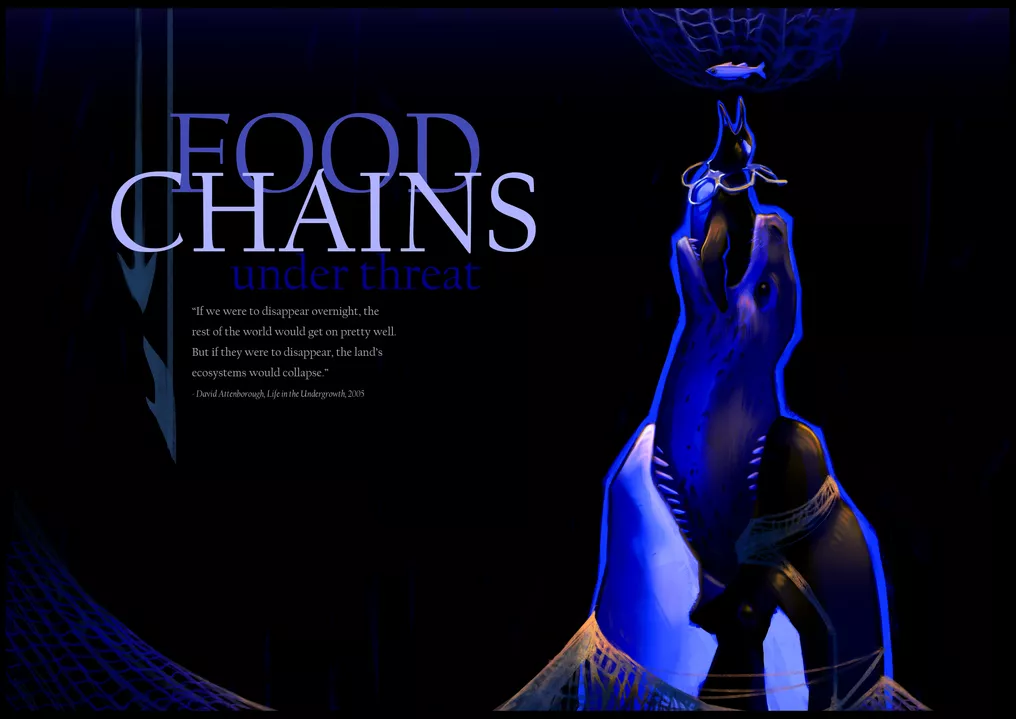
Page spread for a nature magazine - Food Chains Under Threat
The intention for my project was to symbolise an ocean food chain within a single image, with the animals along the chain being afflicted by an environmental issue caused by humanity: the fish is caught in a fishing net to represent overfishing; the penguin has plastic can ring holders stuck around its neck to represent plastic pollution; and the orca is tangled in netting to represent both over-hunting and accidental entanglement. I wanted to signify that humanity is having a devastating effect on animals on every trophic level of the food chain and that this is causing an imbalance in the natural order, therefore threatening endangerment for many species.


Friday, 8 April 2022
Rimi Dudhia- Animal Cruelty

I had decided to incorporate this topic of animal cruelty with rabbits into my final piece. My final piece of artwork is simple, yet portrays a clear storyline of how easily rabbits are abused for experiments. The blue background towards the outside draws attention to the actual topic going on in my piece. The rabbit quickly goes from a healthy state to an unhealthy state as it is experimented on.
Octopus Meets Sushi Chef- Oren Somers-Baines
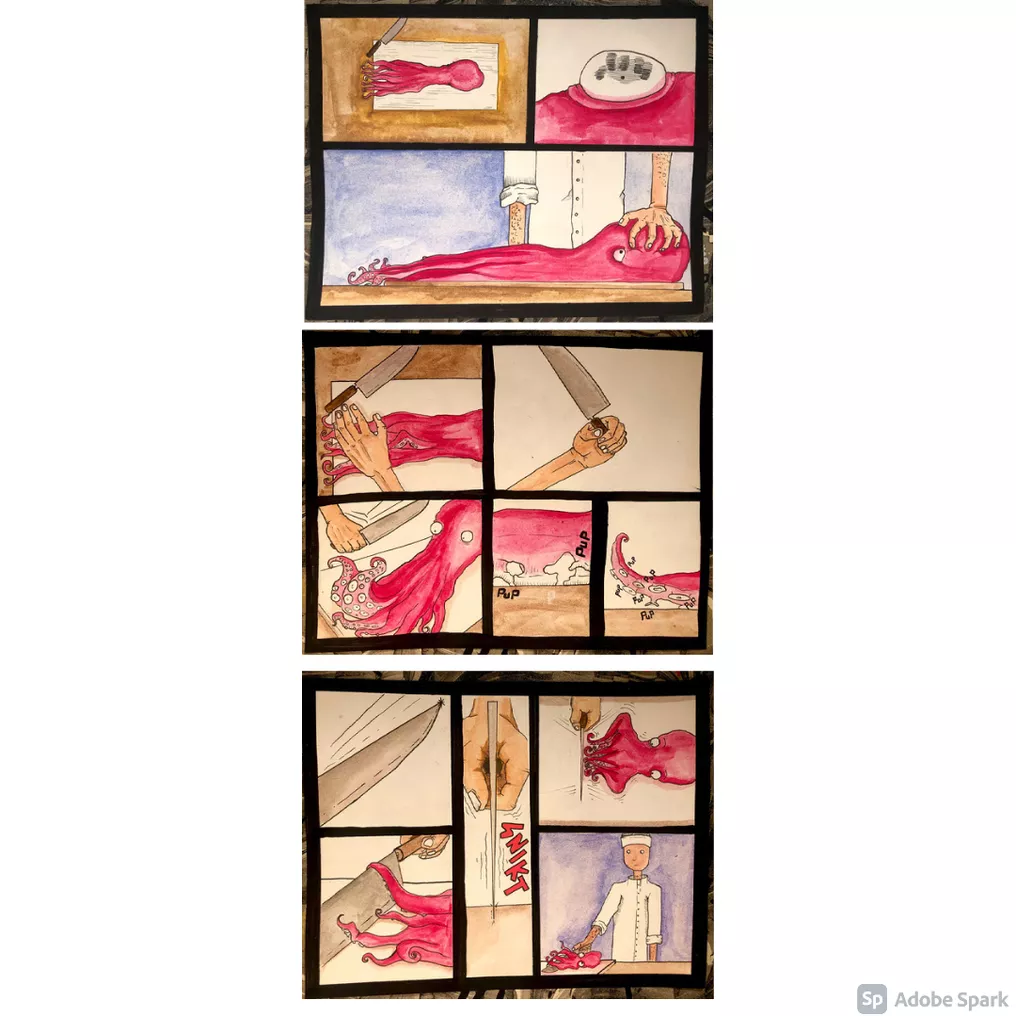
I had lots of fun and boring options of an octopus swimming or crawling but wanted to add another animal and take him away from his natural habitat and do the end of the food chain for him. Luckily he's a smart one and is shown dodging the knife. I wanted to show the struggle and urge that the octopus has against the pain and inevitability of painful death. Octopus are very intelligent creatures - not only do octopus experience physical pain when abused, they are capable of feeling emotional pain. Imagine seeing your fellow octopus being dismembered and you're next - just feel its inhuman on the octopus to be killed alive like that.
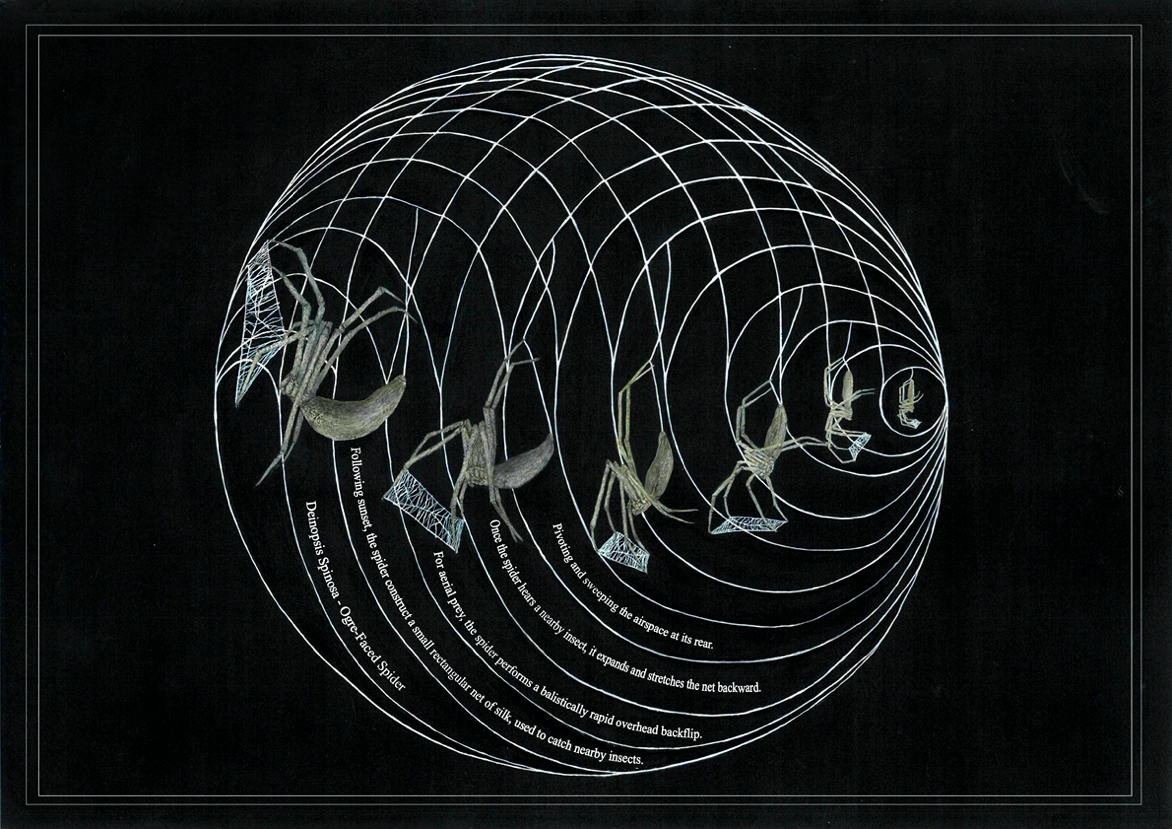
Ogre-Faced Spider Hunting Behaviour - Tara Hughes
Deforestation - Natasha Cole
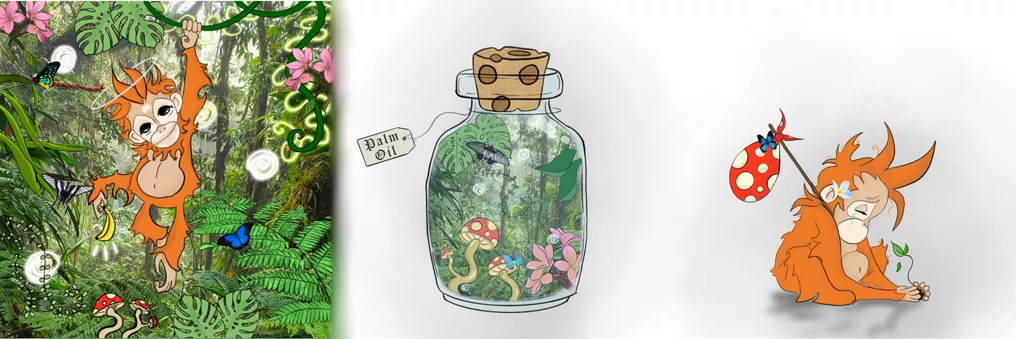
For this project I started looking into orangutans and how their homes are being threatened by the mass production of palm oil.
Bats as Pollinators - Jazmin Johnson

Throughout this project, I researched bats and their importance within our ecosystem. I looked into many different conservations of Bats, and one which stood out the most to me was “Bats as Pollinators. This animated loop depicts the importance of pollination, and how “Bee’s have the day shift, Bats have the night shift”.
The Butterfly Effect - Sara Gica
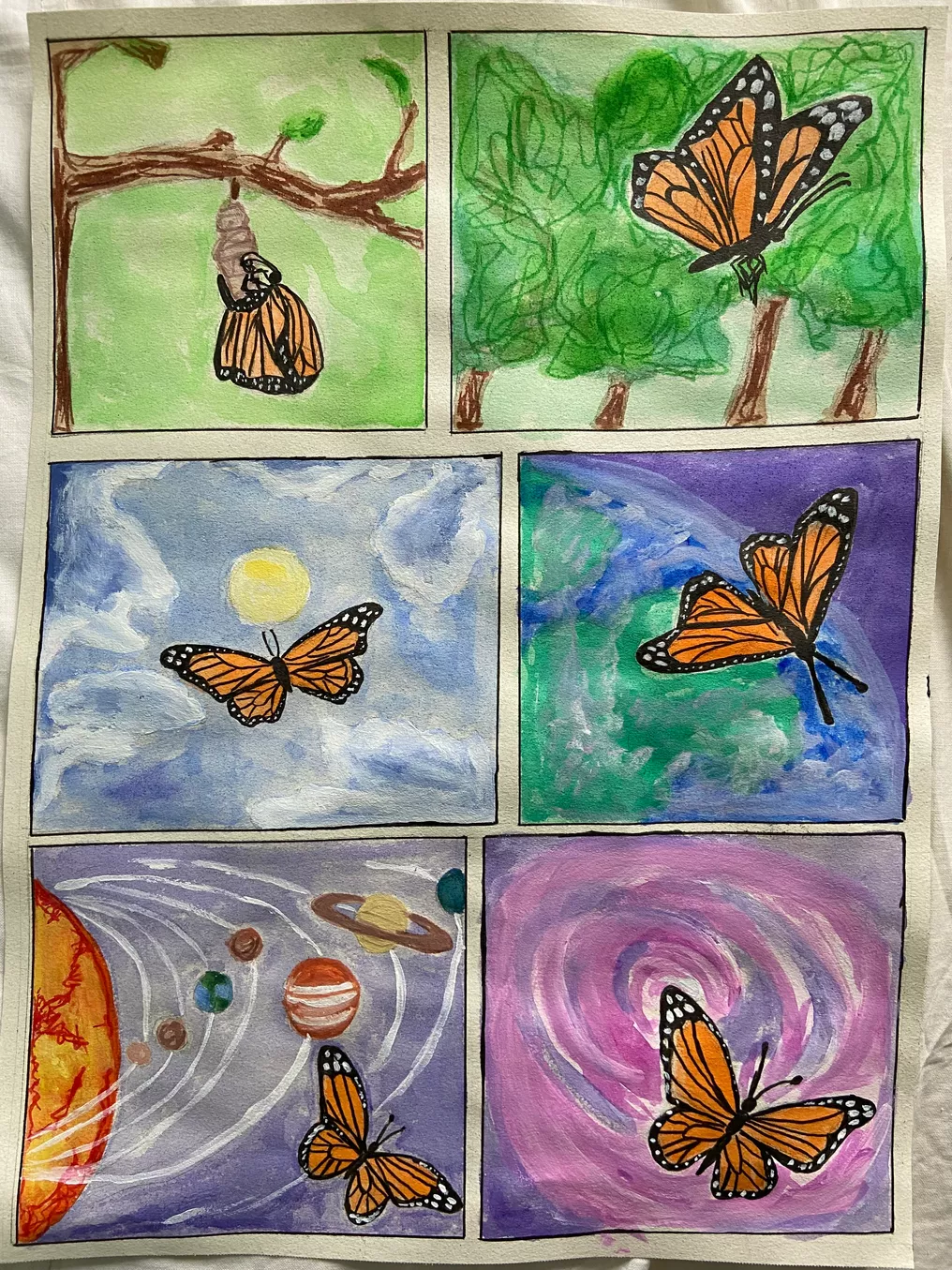
For my final project I chose to research butterflies, their life cycle ( how they are born as caterpillars then undergo metamorphosis), and their symbolism in the widely known theory, The Butterfly Effect. The theory states that even the smallest changes somewhere can prompt significant changes elsewhere. For my project I tried to represent this idea visually by having a butterfly emerge from its cocoon, fly over Earth, surpass the Solar System and the Milky Way galaxy. The butterfly itself is a metaphor for change and transformation, and once it has emerged from its cocoon it just flies as far as it can, similar to how many changes that occur on Earth can have impact on the larger Universe as a whole.
The Evolution of Pugs - Paige Y

The wild animal in your house - Teddy Hunter
Thursday, 7 April 2022
Tuesday, 5 October 2021
Procreate animation for Inktober21.
The prompt was 'Raven' - the frames are hand drawn and inked in layers then exported as an animated gif.

Monday, 15 February 2021
Sequential Illustration; A brand new module! The following posts are projects which illustrate something sequential about an animal
Ruby Gregory
This sequence depicts a squirrel trying to get to the food inside a squirrel proof bird feeder which is weight sensitive. meaning that when a squirrel attempts to jump onto it, it will spin stopping it from getting into the birds feeder.
The sequence shows that a squirrel won’t give up and will do and try anything they can to get their food, which I illustrated with a GIF I created on a loop to show a squirrels life on the struggles they would go through to get food.
I'd made leaf prints to use as a stencil on the squirrels to show its nature and where they live. I thought the effect of having the squirrels as leaves looked like another sequence of leaves blowing through the wind.

This sequence depicts a squirrel trying to get to the food inside a squirrel proof bird feeder which is weight sensitive. meaning that when a squirrel attempts to jump onto it, it will spin stopping it from getting into the birds feeder.
The sequence shows that a squirrel won’t give up and will do and try anything they can to get their food, which I illustrated with a GIF I created on a loop to show a squirrels life on the struggles they would go through to get food.
I'd made leaf prints to use as a stencil on the squirrels to show its nature and where they live. I thought the effect of having the squirrels as leaves looked like another sequence of leaves blowing through the wind.

Emma Evans
I decided to look closely into genetic modification and evaluating the extent of understanding what is too far? I wanted to portray the aspect that mice are used as the first testing stages as they are similar to humans and are of a mass population, personally I find that this isn’t a good enough reason to just make them glow in the dark!
Genetic modification is getting too much, it is now accessible to everyone and anyone, through a kit you can buy online; how many more glowing in the dark animals are we going to have? My aim was to create an expressive sequential illustration that metaphorically demonstrates the unnatural extent of making an animal glow. My final piece would be seen in a newspaper or as a poster.

I decided to look closely into genetic modification and evaluating the extent of understanding what is too far? I wanted to portray the aspect that mice are used as the first testing stages as they are similar to humans and are of a mass population, personally I find that this isn’t a good enough reason to just make them glow in the dark!
Genetic modification is getting too much, it is now accessible to everyone and anyone, through a kit you can buy online; how many more glowing in the dark animals are we going to have? My aim was to create an expressive sequential illustration that metaphorically demonstrates the unnatural extent of making an animal glow. My final piece would be seen in a newspaper or as a poster.
Sunday, 14 February 2021
Michael Dymock
Throughout this project I have explored a number of different sealife animals before settling on seahorses. I started the project looking at their ‘predawn dance’ within their courtship process, however my focus shifted once discovering their depleting numbers through ocean pollution and use within the medical field. My goal for my sequential illustration was to create an empathic response and send a clear and concise message of marine life conservation. I believe this message is strengthened when examining the grungy and desaturated colour pallet used (a clear juxtaposition from their usual vibrancy), along with imagery of medical equipment, ocean litter and metallic features within the image.

Throughout this project I have explored a number of different sealife animals before settling on seahorses. I started the project looking at their ‘predawn dance’ within their courtship process, however my focus shifted once discovering their depleting numbers through ocean pollution and use within the medical field. My goal for my sequential illustration was to create an empathic response and send a clear and concise message of marine life conservation. I believe this message is strengthened when examining the grungy and desaturated colour pallet used (a clear juxtaposition from their usual vibrancy), along with imagery of medical equipment, ocean litter and metallic features within the image.

Veronika Antlova
I decided to illustrate a story about a former family dog that was once adopted from a shelter as a Christmas present and now abandoned and left to his own fate. By choosing this theme and illustrating this story, I wanted to raise awareness of irresponsible dog adoptions, dog abandonment and animal cruelty.

I decided to illustrate a story about a former family dog that was once adopted from a shelter as a Christmas present and now abandoned and left to his own fate. By choosing this theme and illustrating this story, I wanted to raise awareness of irresponsible dog adoptions, dog abandonment and animal cruelty.

Hannah Mcgrain
I focused on rhino poaching. While researching I found out that most of the poaching happens in South Africa so I based my zine on this location. The reason why I created a zine is that I wanted to make people aware of how serious this problem is but in an engaging way; creating a zine allowed me to fulfil the project brief as it is is a clear way to convey a story or information within a series of images. While researching zines a graphic designer David Carson influenced my work, I tried to experiment with his style with experimenting with the type. I did this by using the warping and distortion tool on Procreate. This gave an effect where some of the text cannot be as easily read, but that’s what I found fascinating in Carson’s work, you cannot read his work clearly but you know what he’s trying to portray.
I focused on rhino poaching. While researching I found out that most of the poaching happens in South Africa so I based my zine on this location. The reason why I created a zine is that I wanted to make people aware of how serious this problem is but in an engaging way; creating a zine allowed me to fulfil the project brief as it is is a clear way to convey a story or information within a series of images. While researching zines a graphic designer David Carson influenced my work, I tried to experiment with his style with experimenting with the type. I did this by using the warping and distortion tool on Procreate. This gave an effect where some of the text cannot be as easily read, but that’s what I found fascinating in Carson’s work, you cannot read his work clearly but you know what he’s trying to portray.

Sophie Hawkins
I started by looking at animals and emotion, focusing on how they emote through facial expressions and body language. I then translated these themes onto foxes as they had become a common through line within my sketchbook. I then shifted my focus onto experimenting with the idea of overlaying multiple images to explore how we perceive animals emotions; this then lead onto the idea of duality within animals and how foxes are perceived (cute, docile, mischievous etc.) verses how they genuinely behave (violent, akin to a vermin etc.). My final solution demonstrates the idea that foxes are more than their stereotypes that are depicted within tv, film and social media.


Anisha Sharma
I have researched dinosaurs and how our idea of them is constantly evolving as scientists and archaeologists discover more fragments of their history on the planet. For my final outcome I have created an animation of a hatching brontosaurus. I also wanted to link to their extinction with the comet flying through, which is the widespread belief about what caused these giants to become extinct.
I have researched dinosaurs and how our idea of them is constantly evolving as scientists and archaeologists discover more fragments of their history on the planet. For my final outcome I have created an animation of a hatching brontosaurus. I also wanted to link to their extinction with the comet flying through, which is the widespread belief about what caused these giants to become extinct.
Jade Haste
My project raises awareness of a deadly virus that affects red squirrels called squirrelpox. Red squirrels affected by this virus develop sores and scabs which leak discharge over time. The virus, when contracted, is serious and is a danger to their population, and the aim of my final outcome was to educate the viewer of the effects of the virus.

My project raises awareness of a deadly virus that affects red squirrels called squirrelpox. Red squirrels affected by this virus develop sores and scabs which leak discharge over time. The virus, when contracted, is serious and is a danger to their population, and the aim of my final outcome was to educate the viewer of the effects of the virus.


Rebecca Downey
Looking at water pollution and how it affects starfish specifically. Throughout my project I explored the ocean and what lies in it. I enjoyed experimenting with colours and textures through different mediums. For my final project my plan is to create a series of images showing the effects of water pollution on starfish, from having one brightly painted colourful piece to one dark, textural and mixed media piece. This sequential image piece below is a screenprinting of a starfish entangled in a black rope, which is slowly being intoxicated by grey polluted water taking over its natural form, colour and texture.
Looking at water pollution and how it affects starfish specifically. Throughout my project I explored the ocean and what lies in it. I enjoyed experimenting with colours and textures through different mediums. For my final project my plan is to create a series of images showing the effects of water pollution on starfish, from having one brightly painted colourful piece to one dark, textural and mixed media piece. This sequential image piece below is a screenprinting of a starfish entangled in a black rope, which is slowly being intoxicated by grey polluted water taking over its natural form, colour and texture.


Holly Cowling
I have chosen to focus my project on the mistreatment of animals but specifically circus animals and elephants. I have researched the narrative of "Murderous Mary", a circus elephant that was given a human punishment (being hung from a crane) as a result of her attacking a trainer that was abusing her. My final piece represents the emotions behind Mary as she was taken from the wild and forced into captivity, I have produced this work as a statement of rebellion against the circuses that continue to use animals in their shows today.
Amber Toman
I have chosen to look at rats and how they are misunderstood in our society but are looked at differently around the world. I’ve chosen to look at zines, especially punk zines for my sequential illustration final piece. My idea is to create a parody of a Punk Zine but to be replaced with my chosen animal of rats, using Anthropomorphism to portray a zine. I’ve found new ways such as digital practice to create new and improved artwork.
Joanna Swiezawska

This project is a personal piece of work and what I would call my rediscovery of mice as species all over again. I’m sharing my own experience with them and a bit of insight about real interactions between both sides of the conflict. I am trying to understand the changes around us that come with mice, the physical and the psychological responses to them. My observations - the initial shock, the denial, the annoyance, the fear - I try to question them in my illustrations.

Amy Tuff
I chose to look at the Kakapo, a critically endangered parrot from New Zealand. I chose this bird because it has a very interesting but unfortunate history with a difficult struggle to save the species.
I wanted to tell the story of this bird through a book of layered paper cut outs as each pages flows and connects to the next.
I chose to look at the Kakapo, a critically endangered parrot from New Zealand. I chose this bird because it has a very interesting but unfortunate history with a difficult struggle to save the species.
I wanted to tell the story of this bird through a book of layered paper cut outs as each pages flows and connects to the next.
Shakira Yunus
From researching elephants I began to develop the theme around circuses and how they exploit these gigantic mammals. I started with drawing the elephant form and experimented with different materials to expose textures. Looking at footage captured both undercover and by the audience, I mapped out the stunts they are expected to successfully complete under the torturing conditions. Below is my final which is on a series focused on stunts performed during circus performances. Charcoal allows me a lot of expressive freedom and control where necessary as I want to evoke emotions from the viewer. This combination is what I explore throughout my sketchbook as I planned to capture the disturbing circus life through tactical imagery and shading.
Jasmine Nicholson
I chose to look at Service/Assistant Dogs and the work they do for those who need support. For example those who suffer with Autism and the support a working dog can bring to change their life. I experimented with drawing using a sewing machine with continuous line drawing to illustrate the "day of the life of an ability dog". I decided to make a working dogs jacket and using a sewing machine illustrate both a sequential narrative of the dog at work and when it is off duty. The jacket would show one side of the dogs life: going to the shops, retrieving objects etc and another: playing, sleeping, being silly etc. A key factor being when they are working, the jacket is visible and when they are not it isn't. Expressing not to disturb a dog while it is working and spreading awareness of what dogs do/what their life is like. I think this could be used in a few different places: on display in a charity shop window, on a working dog, in the training studio or mounted as a poster. Being used to educate those who need it. I really enjoyed my first attempt at illustrating on a machine and felt it successfully presented my sequential image.


Eleanor Kill
A series of images which show different types of whales which have somehow been affected by humans. I started out by researching and drawing different types of whales. Then my research took me to looking at captive whales and how humans seem to exploit them. I found mostly Orca whales are most famously known for performing in shows and as a result deaths have occurred, however I also found that Beluga whales are also commonly found in captivity but because little is known about them they don’t seem to be a focus point for stopping captivity of whales. I also found that Blue whales have also been affected by human activity. Therefore I focused my drawings around these three whales. I started by sketching, then I tried out different media. I liked using procreate, so I decided to use this for creating my final piece. I wanted to create a series of images which where also informative and therefore could be used to educate as well as look effective. I wanted to include the skeletons of the whales because it shows if humans carried on treating the whales how we once did the skeletons would be the only evidence that these creatures existed but however in recent years our attitudes have changed towards these creatures.
A series of images which show different types of whales which have somehow been affected by humans. I started out by researching and drawing different types of whales. Then my research took me to looking at captive whales and how humans seem to exploit them. I found mostly Orca whales are most famously known for performing in shows and as a result deaths have occurred, however I also found that Beluga whales are also commonly found in captivity but because little is known about them they don’t seem to be a focus point for stopping captivity of whales. I also found that Blue whales have also been affected by human activity. Therefore I focused my drawings around these three whales. I started by sketching, then I tried out different media. I liked using procreate, so I decided to use this for creating my final piece. I wanted to create a series of images which where also informative and therefore could be used to educate as well as look effective. I wanted to include the skeletons of the whales because it shows if humans carried on treating the whales how we once did the skeletons would be the only evidence that these creatures existed but however in recent years our attitudes have changed towards these creatures.


Simran Gurung


I have studied the sequence of bee pollination and how crucial it is to our natural world and ecosystem. Using textiles and sewing inspired by the natural, organic process of pollination, I have created a piece portraying the vast power one bee alone holds in the prosperity of our living world, inspired by a powerful statistic included in my image. I have really enjoyed exploring textiles and sewing for the first time across my work, incorporating machine embroidery, hand sewing, tactical composition of fabrics and using the back of my sewing work in some areas to create interesting layers, textures and lines in my image. I think my image could be seen in an educational magazine or online campaign for environmental awareness. Overall, I loved exploring textiles, a medium which is new to me, and feel I have created an impactful, interesting sequential image.


Elise Costain

I chose to look at a more broad idea of animals in sequential imagery, I decided to look at people who have rare species for pets. Especially with the cultural boom of the docuseries Tiger King, I have a heightened awareness about people with extraordinary and endangered animals as pets. Also the idea of the modern social media influencer advancing to a stage where the new ‘in’ thing is to have a crazy pet seemed like a fun idea to me.

Laura Louise McDonagh
My project researches into the history of the London zoo, in particular focusing on a tale of a ghost bear seen at the Tower of London. In my final piece I wanted to illustrate this story in a tarot card style print, combing ideas of three dimensional space and aiming to make it seem like the prints are moving to bring the story to life.

Ollie Keefe-Magan
I looked at the practice of Chinese medicine which has traditionally involved using various body parts of tigers to be crafted into different medicinal and pharmaceutical items. I have researched the different body parts that have been used within these medicines and why they are used. I wanted my final piece to showcase a tiger drawn in a Chinese folk style to gradually melt throughout the page to represent the use of tiger bodies in a grotesque craft.

I looked at the practice of Chinese medicine which has traditionally involved using various body parts of tigers to be crafted into different medicinal and pharmaceutical items. I have researched the different body parts that have been used within these medicines and why they are used. I wanted my final piece to showcase a tiger drawn in a Chinese folk style to gradually melt throughout the page to represent the use of tiger bodies in a grotesque craft.

Asare Afjool

The focus of my work was the exploration of honey bees decline causes and how air pollution cuts the short life span of wild honey bees. I set out my work by using different techniques such as line drawing, printmaking, collage, etc. through my drawing process I endeavoured to explore a new way to save bees from extinction because if they die we will die too, my final work includes a very friendly message all about plant flower to save pollinators.

The focus of my work was the exploration of honey bees decline causes and how air pollution cuts the short life span of wild honey bees. I set out my work by using different techniques such as line drawing, printmaking, collage, etc. through my drawing process I endeavoured to explore a new way to save bees from extinction because if they die we will die too, my final work includes a very friendly message all about plant flower to save pollinators.
Kirsten Randall
I chose to look into the domestication of bunnies, and how they went from the common wild breed to the many domestic breeds through selective breeding. I also looked at the sequence within a rabbit's binky, a jumping instinct in common with all the breeds. For my final piece I illustrated the timeline of rabbit domestication in the form of a binky as an animated gif.

I chose to look into the domestication of bunnies, and how they went from the common wild breed to the many domestic breeds through selective breeding. I also looked at the sequence within a rabbit's binky, a jumping instinct in common with all the breeds. For my final piece I illustrated the timeline of rabbit domestication in the form of a binky as an animated gif.


Subscribe to:
Posts (Atom)